

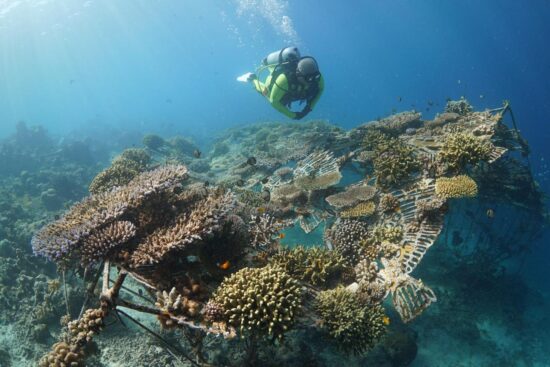
A documentary traces the life and work of Teguh Ostenrik, an Indonesian fine arts maestro, culminating in the creation of ARTificial Reef. This series of twelve underwater sculptures serves not only as monumental artworks but also as new habitats for marine ecosystems across Indonesian waters.
The film portrays Teguh’s effort to unite art and nature, particularly the sea. Motivated by concern over damaged marine ecosystems—and by a longing for the silence he could not find in studios or galleries—he created ARTificial Reef: an underwater installation that functions as both art and a living home for corals and fish. Through a personal and reflective narrative, the documentary reveals a creative process that is artistic, scientific, and spiritual. Teguh collaborates with divers, scientists, and coastal communities, underscoring the need for interdisciplinary cooperation and ecological awareness.
ARTificial Reef is more than a statue on the seabed; it is a quiet invitation to reconnect with nature. The film presents art as a tool for healing, a source of hope, and a reminder of values nearly forgotten—born from damage, nurtured by gratitude, and rooted in deep love for the earth.
Designed as a dual-purpose work—both art installation and artificial coral reef—ARTificial Reef has been submerged in several Indonesian waters since 2015.
The documentary, titled Bisikan Terumbu, introduces Teguh’s journey and expands public access to this visual and environmental movement. Selasar Sunaryo Art Space (SSAS), in collaboration with Artopologi and Yayasan Terumbu Rupa, held a screening and discussion at the SSAS Amphitheater in Bandung on Tuesday, September 30, 2025.
During the discussion, Teguh addressed the worsening condition of marine ecosystems, largely caused by irresponsible human activity. He emphasized the ocean’s vital role in sustaining life, noting that nearly 70 percent of the oxygen produced each second comes from marine biota living in coral reef ecosystems.
Shaped like a turtle, ARTificial Reef has been installed in eight locations: Senggigi (Lombok); Sembiran and Bondalem (North Bali); the Thousand Islands; Bangsring (Banyuwangi); Wanci Island (Wakatobi, Southeast Sulawesi); Bangka Island (North Sulawesi); and Jimalamo (Ternate).
For Teguh, who has loved the sea since childhood, creating art means creating impact. He describes ARTificial Reef as a movement born from deep love for the ocean—a fusion of art, science, and life.
For more than a decade, Teguh and his wife, Mira Tedja, have opened spaces for dialogue with experts from various fields. His artistic journey extends beyond visual art, crossing disciplines and requiring complex collaboration.
“ARTificial Reef could not have been created by one person alone,” Teguh says in the film. “It emerged from a collaborative ecosystem involving artists, scientists, marine experts, divers, local communities, technicians, and spiritual leaders. Each brings their own knowledge, intuition, and experience.”
Bisikan Terumbu is directed by Arfan Sabran, produced by Dion Pandu Dewantara, and executive produced by Intan Wibisoni and Mira Tedja. The film is supported by the Ministry of Culture of the Republic of Indonesia, LPDP, Dana Indonesiana, Artopologi, and Yayasan Terumbu Rupa.
Intan Wibisoni, Founder and CEO of Artopologi, explains that the documentary aims to inspire audiences to contribute to ocean conservation and to generate new ideas for coral reef rehabilitation in Indonesia.
One distinctive aspect of the production is its balanced portrayal of land and sea. Many crew members, including the cinematographers, are divers with a deep connection to the ocean, enabling them to translate Teguh’s philosophy into compelling visuals.
The team documented the project over a long and complex period, weaving years of footage—films, videos, photographs, and research archives dating back to 2014—into a cohesive and accessible narrative.
Director Arfan Sabran is an Indonesian documentary filmmaker. His debut film, Suster Apung, won Best Film and Best Cinematography at the Eagle Awards 2006. His feature-length debut, The Flame (Bara), premiered at Visions du Réel in 2021. He also produced Rabiah and Mimi, which won at the Tokyo Docs 2019 pitching forum and secured an international co-production with TBS Sparkle Tokyo, later premiering on NHK Japan. []