

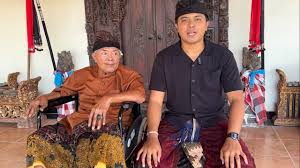
Balinese dance maestro I Made Djimat, now 84, has been honored with the Parama Satya Budaya—Gianyar Regency’s highest cultural award—in recognition of his lifelong dedication to preserving and advancing Balinese arts and culture.
The honor was conveyed by the Gianyar Regency Cultural Office in collaboration with the Gianyar Regional Bali Cultural Council, acting on a direct mandate from Regent Made “Agus” Mahayastra. Representatives visited Djimat at his residence in Banjar Pekandelan, Batuan Village, Sukawati, Gianyar, on Wednesday (April 1). The formal presentation will take place during the peak of Gianyar City’s anniversary celebrations in mid-April.
Djimat received the news with evident warmth, smiling throughout the visit and occasionally laughing during the gathering. The Parama Satya Budaya Award includes a certificate, a gold pin, and a grant of Rp75 million to Rp100 million, along with support for the art studio he founded in 1971.
Widely regarded as a cultural ambassador, Djimat has brought Balinese performing arts to international audiences since his youth. He is especially renowned as a master of Jauk Dance and Topeng Tua, and remained active on stage well into his later years, most recently performing in Jakarta in October 2025 as part of the “Maestro” series.
Beyond performance, Djimat has made a lasting impact as a mentor. Under his guidance, numerous art groups have achieved top honors at major events, including the Bali Arts Festival and other prestigious competitions.
Even at 84, he continues to embody the vitality of a true master. Though he now spends much of his time in a wheelchair, his command of movement remains precise. He still occasionally demonstrates techniques—from tanjek and nyeledet to the nuanced expressions of masked dance—often with a smile as he engages with his children and grandchildren.
A central influence in Djimat’s artistic life is Gambuh, a classical dance drama that integrates movement, music, theater, visual art, and literature. Drawing on Panji narratives of romance and conflict, Gambuh is considered a foundational form in Balinese performance, shaping many of the island’s later dance traditions. Typically performed in ceremonial contexts, it encompasses a wide emotional range—from humor and tension to elegance and grace.
More than an artistic form, Gambuh carries deep aesthetic, ethical, and moral significance. Its stories explore themes such as leadership, loyalty, and social harmony, while each performance is accompanied by ritual offerings, reflecting the inseparable bond between art and spirituality in Balinese culture.
Born into a family of artists, Djimat is the son of I Nyoman Reneh and Ni Ketut Cenik, both of whom were involved in dance and painting. He began learning from his parents at an early age, starting with the Baris dance before expanding his repertoire to include Gambuh, Jauk Manis, and Jauk Keras.
As a child, he was captivated by watching adult performers and gradually began imitating their movements alongside his peers. He often accompanied his father to dance lessons, using these moments to refine his technique. His persistence soon led to opportunities to perform at odalan temple ceremonies.
Djimat received his formal education at Sekolah Rakyat (elementary level) but left school in the fifth grade to fully pursue his artistic calling. He later joined his parents in teaching prembon (dance drama) across various parts of Bali, further honing his craft. Open to learning from anyone, he cultivated both technical skill and a deep understanding of narrative—an essential element in bringing dance drama to life.
By the early 1960s, Djimat had won several traditional dance competitions, gaining widespread recognition. His reputation led to teaching engagements across Indonesia and abroad, with his artistry taking him to international stages.
Amid the pressures of globalization, Djimat has remained steadfast in his commitment to cultural preservation. As mentor of the Tri Pusaka Sakti Studio in Gianyar, he continues to encourage younger generations to embrace and sustain their artistic heritage, keeping the spirit of Balinese tradition alive. []