

By Edo Pop
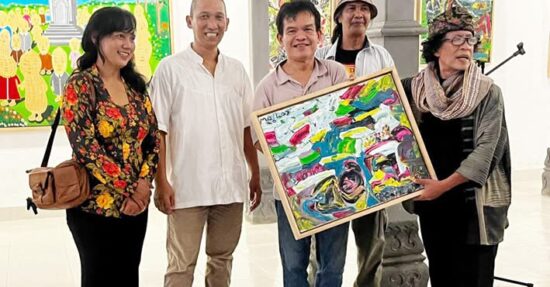
The exhibition Rupa 3 Rupa brings together three artists—Afnan Malay, Kaji Habeb, and Luwi Darto—each distinguished by a unique visual language. Rather than merely highlighting their differences, the exhibition celebrates the diversity of perspectives through which personal experience is translated into art. Their works emerge from inner reflection, memory, and environmental awareness, shaping distinct artistic identities embedded in each piece.
Held at Jiwa Jawi Gallery from April 3 to 28, 2026, the exhibition creates a space where expression and impression intersect, fostering a subtle dialogue between inner life, lived experience, and perception. Some works appear as powerful articulations of meaning, while others leave delicate traces of sensation, inviting viewers to engage with layered emotions and ideas. More than a presentation of visual forms, Rupa 3 Rupa encourages reflection on human experience, collective memory, and the shifting dynamics of contemporary life through a journey that blends sensitivity, contemplation, and interpretive openness.
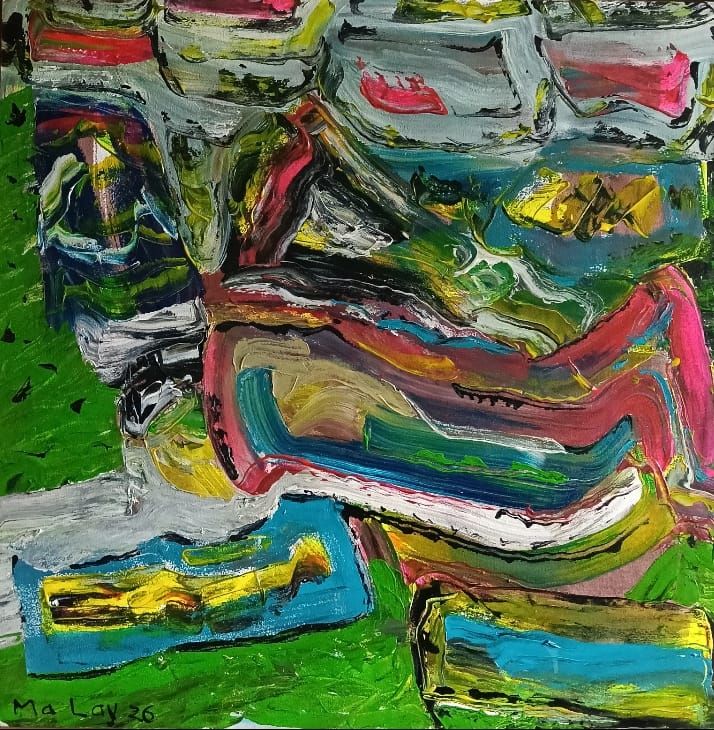
Afnan Malay’s abstract works reveal transitional spaces through subtle yet decisive visual fragmentation. Rather than representing concrete forms, his expression unfolds through gesture—layers of color, fluid lines, and tactile textures that register the movement of the artist’s hand. In Moored Boats (80 x 80 cm, AOC, 2026), color operates as an open visual event: blue, green, red, and yellow converge, collide, and settle into shifting sensations rather than fixed meanings. Impression emerges in the intangible space between these elements—blue evoking the memory of slow-moving water, green suggesting calm expanses, while red and yellow introduce intermittent pulses of energy. The composition remains deliberately ambiguous, forming an atmosphere rather than a definitive narrative.
The rhythm of curved, broken, and repeated lines creates a sense of unstable movement, where the eye drifts, pauses, and resumes—like a boat suspended between stillness and motion. Texture reinforces this dynamic: thick layers of paint preserve the intensity of action, while the absence of a central focal point allows meaning to remain fluid and open. In this way, the work is experienced rather than read; expression becomes the point of entry, and impression its unfolding resonance.
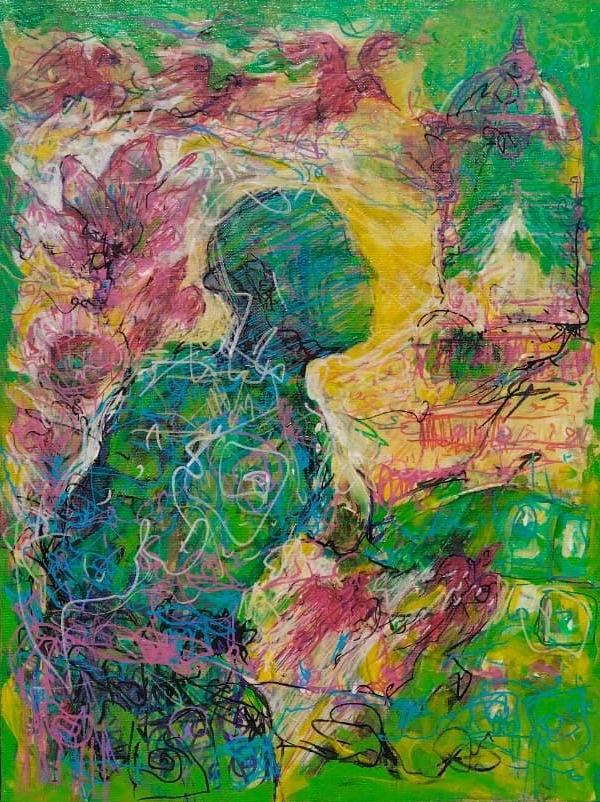
In contrast, Kaji Habeb’s Ziarah (60 x 70 cm, AOC, 2026) articulates expression through symbolism and rhythmic repetition. Patterns of lines, colors, and forms evoke the cyclical nature of spiritual practices such as prayer, recitation, and fasting. These visual elements do not function as literal representations, but as symbolic pathways into inner experience. Repetition becomes both a visual and spiritual mechanism, reflecting discipline, contemplation, and the gradual process of self-purification.
The central green figure serves as a marker of an internal journey rather than a physical presence. As a symbol, green suggests life, growth, and hope—qualities that resonate with ongoing spiritual development. Intersecting lines across the figure create a rhythm reminiscent of wirid or dzikir, dissolving the boundary between conscious and unconscious states. These marks become traces of inward processes: unspoken prayers, unresolved tensions, and the persistent search for transcendence. Fluid spatial relationships further emphasize pilgrimage as a non-linear experience, where boundaries between figure and environment dissolve. Symbols remain open-ended, inviting reflection rather than offering fixed meaning, and allowing impression to emerge gradually through contemplation.
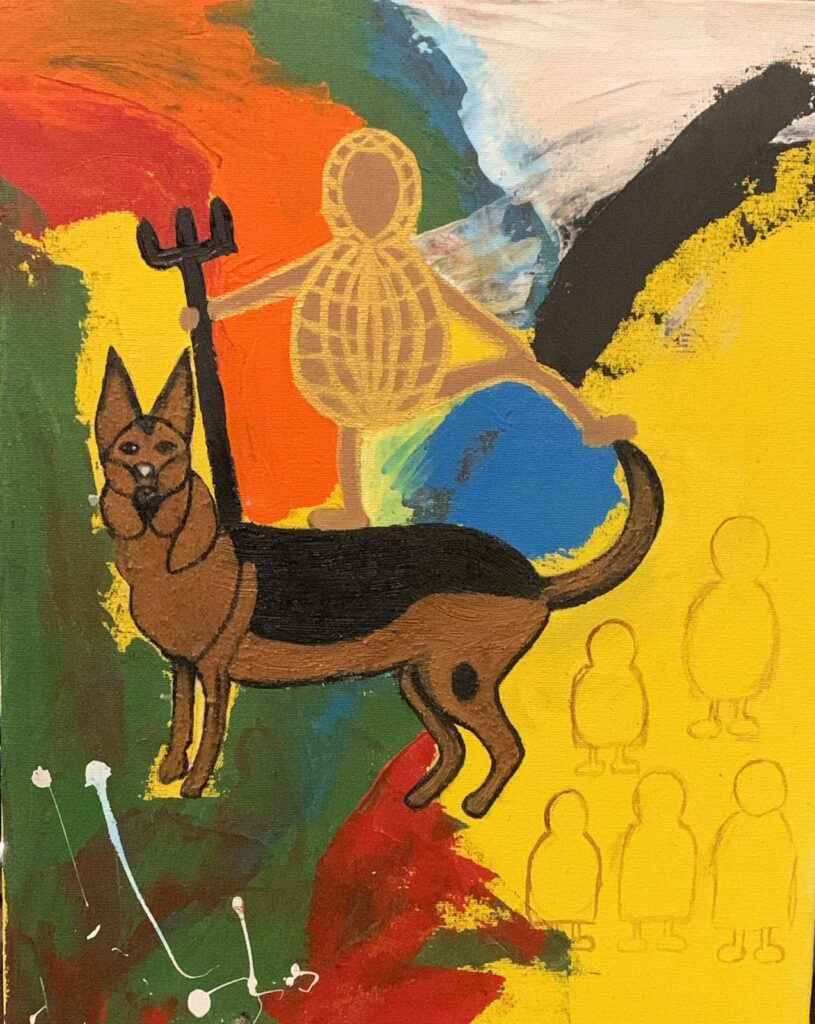
Meanwhile, Luwi Darto’s Raja Kirik (59 x 40 cm, AOC, 2026) adopts a figurative approach to explore layered social structures. The relationship between the “king” and the “puppy” becomes an entry point into questions of power, loyalty, and hierarchy. The dog figure appears grounded and instinctual, suggesting both sincerity and ambiguity—it may represent genuine loyalty or function as a metaphor for complicity within systems of power.
Above it, a translucent human figure evokes the image of a “king,” yet remains fragile and undefined, emphasizing power as a constructed and continuously reinforced condition rather than an inherent quality. Repetitive patterns across the figure’s body symbolize the systems that sustain authority—mechanisms through which power is formed, maintained, and transmitted. The presence of a staff or trident further underscores that power can exist independently of individuals, operating as a structure that extends beyond them.
Through these figurative elements, expression constructs a nuanced social narrative. The composition invites multiple interpretations, while the contrasting color palette generates emotional tension. The resulting impression suggests that power is not sustained solely through domination, but also through organized loyalty and participation. Raja Kirik thus reveals the complexity of social roles and the subtle dynamics that uphold authority.
Together, these three artistic approaches affirm that expression in art is never singular. It may take the form of abstraction, symbolism, or figuration, yet it is always rooted in impression—lived experience that precedes and shapes visual articulation. The relationship between impression and expression is not linear, but cyclical: impression gives rise to expression, which in turn generates new impressions. Within this cycle, artworks remain open, continually inviting reinterpretation.
To encounter these works is to enter a transitional space where meaning is not imposed, but allowed to evolve. What is felt does not require immediate explanation; ambiguity is embraced, and the unseen is given presence. Here, art becomes more than a visual object—it becomes a trace of inner life, a fragment of experience, and a site where consciousness and the unconscious intersect.
Through this interplay emerges a deeper awareness of self and other. Identity is not fixed, but continuously shaped through interaction, memory, and reflection. Art, in this sense, becomes a medium through which personal and collective experiences converge, allowing viewers to recognize themselves within others and others within themselves.
Ultimately, Rupa 3 Rupa positions art as an evolving field of encounter—between expression and impression, the visible and the hidden, the individual and the collective. Afnan Malay opens a space for emotional freedom and interpretation; Kaji Habeb reveals layered spiritual meanings through symbols; and Luwi Darto reflects on social realities through figurative narratives. Together, they demonstrate that art is not merely a form, but a living process—one that continues to shape and deepen our understanding of what it means to be human. []
Edo Pop, an activist at Gugum Tapa, Yogyakarta, was born on August 21, 1972, in the village of Sriguna, Kayuagung, Ogan Komering Ilir (OKI) Regency, South Sumatra. A painter whose work has been exhibited in Yogyakarta, Jakarta, and Surabaya since 1996—as well as internationally in Denmark and Singapore—he is widely recognized for addressing issues of oppression against women in Indonesia, particularly within patriarchal culture. He currently resides in Yogyakarta.


